

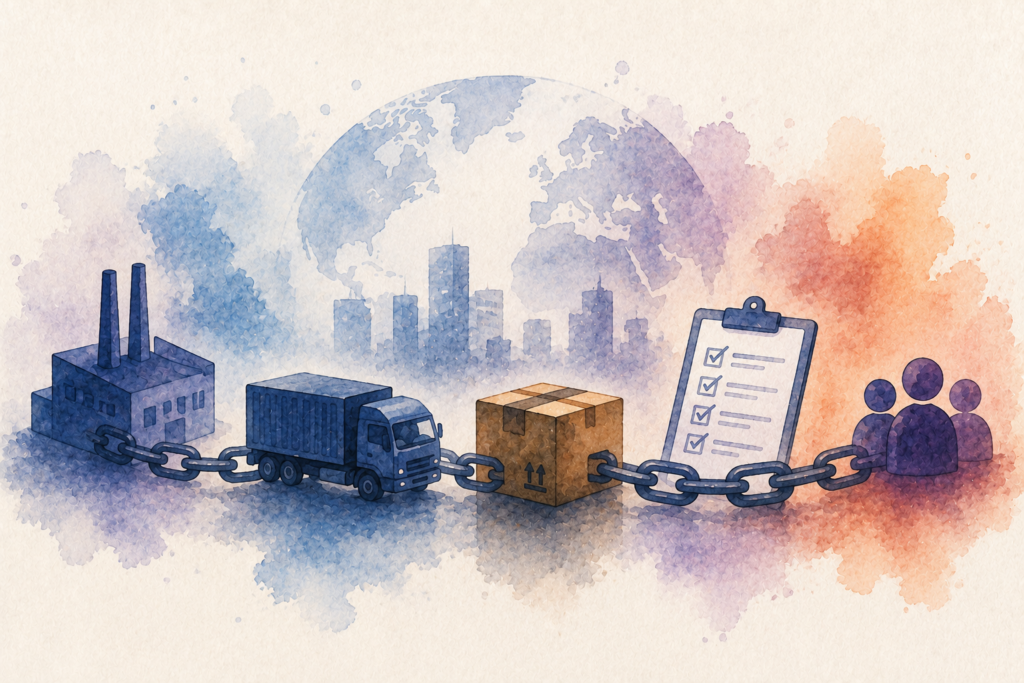
The Security Risks You Can’t See: Assets, Suppliers, and AI Platforms
Ransomware activity, actively exploited vulnerabilities, and security weaknesses in AI engineering platforms all point to a common challenge: organizations need clear visibility into the technology and third-party relationships that support daily operations. For mid-market businesses in particular, a disruption can affect internal systems, customers, suppliers, and the continuity expectations that connect them.
Ransomware Risk Extends Across the Mid-Market Supply Chain
Black Kite’s findings indicate that medium-sized organizations represented 73% of ransomware incidents observed between 2023 and the first half of 2026. This pattern is significant because mid-market organizations often sit at important points within business supply chains, relying on external software, technology, logistics, and service providers while supporting larger customers with their own security and continuity expectations.
A ransomware event can create more than an internal operational problem. When systems, data, or services are disrupted, the effects may extend across connected business relationships. Organizations may face questions about service availability, contractual obligations, handling of customer information, and the security of systems shared with suppliers or partners.
Supplier-risk oversight can be difficult when security and procurement teams have limited resources. Organizations may need to understand whether key suppliers maintain appropriate security practices, have incident response capabilities, and apply suitable controls to access shared systems or sensitive information. At the same time, extensive continuous monitoring may be difficult to sustain.
Customer expectations can add further pressure. A mid-market organization may remain responsible for protecting customer data and maintaining service continuity even when a supplier contributes to an exposure. This makes ransomware a third-party risk consideration as well as an internal security concern.
Known Exploited Vulnerabilities Affect Core Enterprise Technologies
CISA’s addition of four critical vulnerabilities affecting Apple macOS, Microsoft SharePoint, VMware vCenter, and Microsoft IKE to its Known Exploited Vulnerabilities catalog highlights another important part of security readiness. CISA’s designation indicates that these vulnerabilities have been observed being exploited, rather than existing only as theoretical risks.
The affected products span several common areas of an enterprise environment. Apple macOS supports endpoint users and local data. Microsoft SharePoint can support internal content, collaboration, and workflows. VMware vCenter may be central to the administration of virtualized systems. Microsoft IKE is associated with network-related Microsoft services. Each technology can occupy a different role, but a weakness in any one of them may create operational and security concerns based on how it is deployed and connected to other systems.
This breadth reinforces the value of maintaining visibility across endpoints, collaboration platforms, infrastructure management systems, and network-related services. An organization cannot assess relevance solely by recognizing a product name. It also needs to understand whether the technology is present in its environment, how it is configured, whether it is exposed, what systems depend on it, and whether updates or mitigations are available.
Vendor guidance and environment-specific information would be needed to determine whether a particular organization is exposed. Still, the inclusion of these issues in CISA’s catalog is a useful reminder that widely deployed technologies require ongoing attention within vulnerability and asset-management processes.
AI Engineering Platforms Need the Same Security Attention as Production Systems
CISA has also warned of a critical security weakness affecting MLflow, an open-source platform used in AI engineering workflows, that is being actively exploited by threat actors. MLflow can support experiment tracking, model management, and deployment-related processes, placing it close to valuable development data and operational AI assets in some organizations.
The potential impact of a weakness in this type of platform may extend beyond a single application. Depending on deployment and integration, exposure could involve connected repositories, credentials, model artifacts, or supporting infrastructure. This is particularly important when development tooling is integrated broadly or connected to systems that hold important operational information.
AI engineering environments can sometimes be deployed quickly to support new development needs. When that occurs, the tooling may be treated separately from established asset-management and vulnerability-management practices. Security exposure can increase if organizations do not have a clear understanding of where MLflow is deployed, whether instances are externally reachable, what systems they connect to, and how access is controlled.
The alert reinforces a broader principle: AI development platforms require the same level of visibility and security attention as other technologies that support critical business operations.
Ransomware trends, known exploited vulnerabilities, and risks affecting AI engineering workflows all illustrate the importance of understanding the systems and relationships that can influence an organization’s security posture. Stronger awareness of assets, dependencies, supplier access, and actively exploited weaknesses supports more informed and timely security decisions.
Yobihouse helps organizations evaluate their cybersecurity posture through structured auditing and consulting services. This can include reviewing technology environments, third-party dependencies, access controls, vulnerability-management processes, and security practices surrounding development and operational platforms. By helping organizations clarify areas of exposure and identify improvement priorities, Yobihouse supports ongoing efforts to maintain security awareness and compliance readiness.