

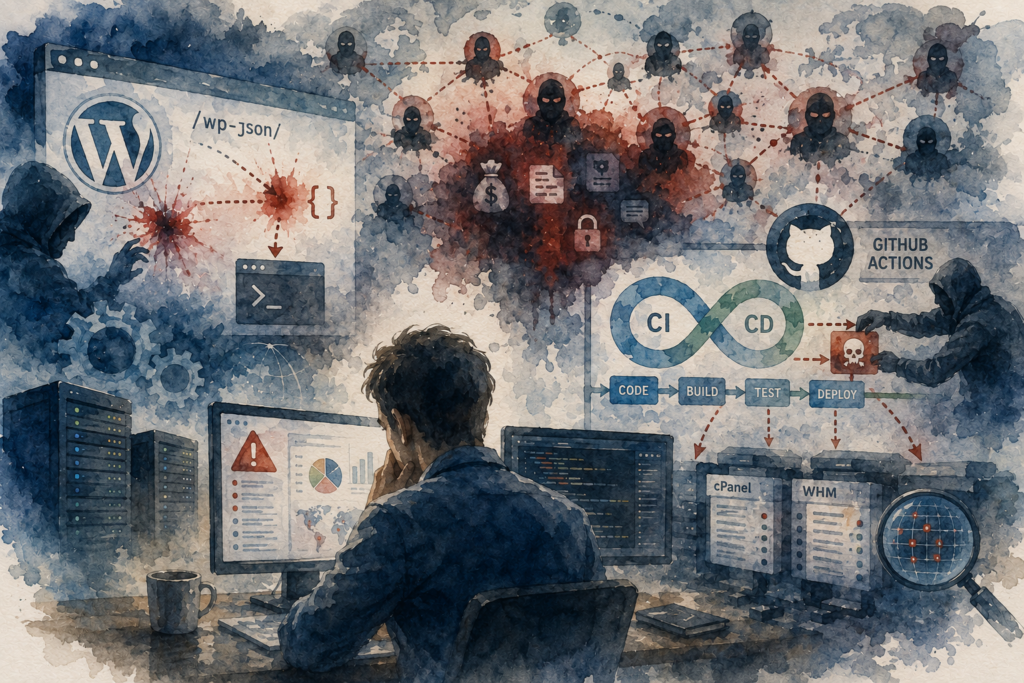
Connecting WordPress RCE Ransomware Fragmentation and CI/CD Pipeline Risks
Modern IT environments face a widening array of threats, from critical open-source platform flaws to the evolving tactics of ransomware groups and the hidden risks within continuous integration workflows. Understanding how these vulnerabilities intersect helps business and IT leaders prioritize defenses that span web applications, infrastructure, and development pipelines. This article examines unauthenticated remote code execution in WordPress Core, the fragmentation of the ransomware ecosystem, and CI/CD pipeline compromises via GitHub Actions.
Unauthenticated Remote Code Execution in WordPress REST API
A recent GitHub Security Advisory highlights two WordPress Core vulnerabilities (CVE-2026-63030 and CVE-2026-60137) that can be chained into unauthenticated remote code execution (RCE) via the REST API. In this scenario, an attacker could execute code on a vulnerable site without valid credentials, exploiting integration endpoints designed for application-to-application communication. Because the REST API is widely exposed, often beyond administrative workflows, the potential attack surface extends to any installation that permits external API calls. The advisory notes that multiple WordPress versions are affected, though organizations must confirm exact version ranges and prerequisites from the primary advisory. The inclusion of these issues in CISA’s Known Exploited Vulnerabilities catalog underlines their real-world significance. A full risk assessment requires additional technical context, including any optional features that enable exploitation and which mitigations effectively block the attack chain.
Fragmentation of the Ransomware Ecosystem and Expanding Attack Surface
Over the past year, ransomware incidents have increased by about 25 percent, driven not by advances in artificial intelligence but by the fragmentation of the criminal ecosystem itself. More than sixty distinct groups now operate as affiliates, service providers, or negotiation specialists, creating a diffuse network that is harder to attribute and disrupt. At the same time, organizations continue to grow their digital footprints across on-premises infrastructure, cloud services, and partner networks. This broadening of entry points means that traditional perimeter defenses and static protection models may leave exploitable gaps for both targeted payloads and automated campaigns. Ransomware actors have also blurred the lines between data theft, encryption-based extortion, and double extortion, complicating response planning. Addressing these challenges calls for dynamic incident response strategies and close coordination among IT, legal, and business stakeholders to ensure resilience against both established and emerging tactics.
CI/CD Pipeline Security: Subversion of GitHub Actions Runners
A recent campaign has shown how attackers can hijack GitHub Actions workflows to turn build pipelines into a distributed reconnaissance network. By first taking control of public and private repositories, adversaries embed malicious steps in workflow definitions that leverage runners’ broad permissions to clone code, install dependencies, and execute arbitrary commands. In the observed case, compromised runners scanned cPanel and WebHost Manager (WHM) servers at scale, using their compute power and network privileges to identify vulnerable hosting control panels. This pattern demonstrates that CI/CD pipelines are not inherently safe and must be treated as part of the attack surface. It also underscores the continued adversarial focus on cPanel and WHM within shared hosting ecosystems. While details on the campaign’s overall footprint and success rate remain under review, the incident serves as a clear reminder to extend security controls and monitoring into development and delivery environments.
No single defense covers the full spectrum of modern cyber threats. Addressing unauthenticated RCE in popular platforms, adapting to a fragmented ransomware landscape, and securing CI/CD pipelines all require proactive, continuous improvement. By mapping these diverse risks and coordinating across teams, organizations can reduce blind spots and strengthen their overall security posture.
Yobihouse offers risk assessments and tailored reviews of web application, infrastructure, and development pipeline security. Specialists can help you prioritize vulnerability remediation, design dynamic incident response plans, and align defenses with compliance requirements. By integrating deep expertise in open-source platform hardening, ransomware resilience, and cyber governance, Yobihouse supports ongoing security and compliance efforts without promising absolute outcomes. Through transparent assessments and ongoing advisory services, your organization gains a structured path to continuous improvement.